0
-
NO PRODUCT IN CART
Empty Cart : €0.00

Reflex Sas constantly checks the quality of its products, in order to supply its customers with warning triangles as well as safety accessories being in compliance with the current concerned rules.
The triangles manufactured by Reflex are type-approved according to ONU 27R03 Standard, which provides for stability tests to verify both windfall resistance and CLI values, as well.
Once a new triangle prototype is ready, we carry out tests to determine stability and safety of the latter. As to Nano warning triangle, Reflex has carried out the required tests for a stability determination, in the wind tunnel, with a minimum windfall resistance equal to 60 km/h. For safety and compliance of the triangles, Reflex has also carried out tests concerning reflector retroreflection as well as tests in dark room to determine CLI values, as provided for by the road safety rules.
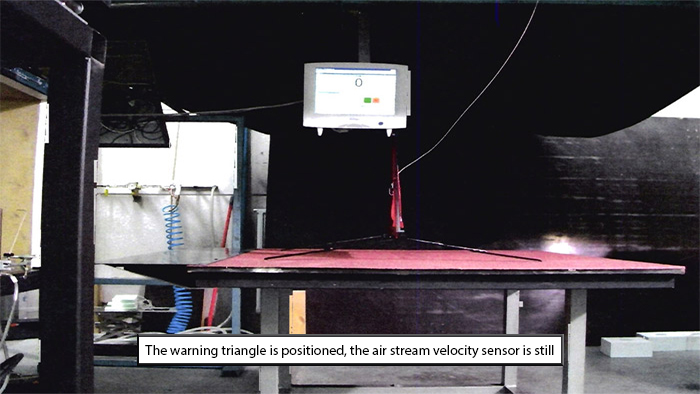
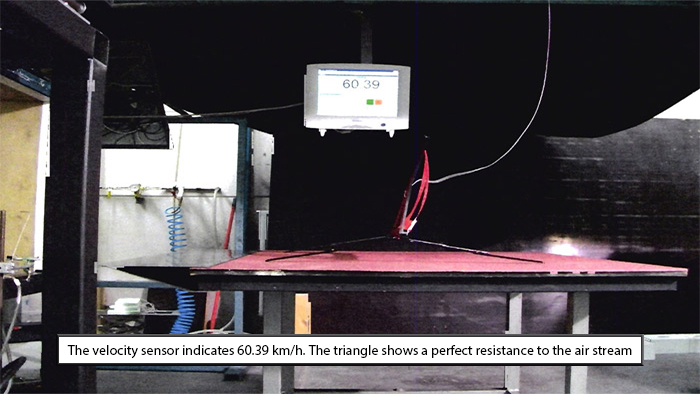
Here below, we have represented the recent test Nano triangle has been submitted to, in order to determine its stability under wind load conditions. All warning triangles produced by Reflex have passed the wind load resistance test in the wind tunnel. Such test shows how Reflex’s triangles are effective, even in case they are submitted to a 60km/h air stream.
Report related to the wind load test carried out the Nano warning triangle has been submitted to in a wind tunnel
Subject: warnig triangles
Test sample marking: numbered warning triangles.
The resistance tests have been carried out as provided for by paragraph 10 of the Exhibit N° 5 of the ECE code N° 27 including amendment 03, which provides for uniform conditions related to a type-approval of warning triangles.
The test concerning the stability of the triangles in a wind tunnel has been carried out by the Institute of Hydromechanical Technique (IfH) – Karlsruhe University. The measuring has been carried out in a Göttinger-type wind tunnel having a nozzle opening equal to 0.73 x 1.05 metres.
The warning triangle has been positioned on a standing base, whose characteristics are in compliance with the provisions being reported in the exhibit N° 4 of the ECE code. A 1.20 x 1.0m plate has been used as warning triangle standing base, the surface of the latter is in compliance with the provisions of the ECE code N° 27 of the exhibit N° 4, in terms of HS roughness = 0.5 mm + 0.05 mm.
The air stream flow in the wind tunnel shall be uniform, have a temperature equal to 24° as well as a pressure equal to 756 Tor (mm Hg) equivalent to 1007.92 hPa.
Warning triangle wind load resistance test carrying out:
The test has resulted in a ratio of approximately 1/9 from the warning triangle surface to the nozzle surface.
The triangle has been positioned on the testing surface consisting of a plate having specific dimensions, as provided for by the ECE code. An air stream has slowly been introduced into the wind tunnel until the air stream speed has reached 60 km/h. Under laboratory conditions, such air stream speed is almost equivalent to a velocity pressure equal to 170 N/m2; a velocity pressure equal to 180 N/ m2 would be reached at 62.1 km/h.
The unit of measurement: “stream velocity”, which has been utilized for the resistance test is a proper test regarding the warning triangles, because they are objects having a solid surface. Therefore, for carrying out a wind load resistance test, in the best way, the stream shall have a homogeneous velocity.
The wind load resistance test is considered as passed when the warning triangle reaches such stream velocity and does not fall over, within 3 minutes, moreover, its movement does not exceed 5 cms from the bearing surface. In addition, the upper triangle part tilt shall not exceed 10 ° towards the exit position. Photos are taken by utilizing a digital camera, to determine such triangle tilt.
The tilt angle is determined according to the following ratio:
tilt angle = tilt angle at 60 km/h – tilt angle in zero position – inaccurate measuring.
The warning triangle is positioned, the air stream velocity sensor is still
The velocity sensor indicates 60.39 km/h. The triangle shows a perfect resistance to the air stream


 Italiano